Showing posts with label CVD. Show all posts
Showing posts with label CVD. Show all posts
Tuesday, July 14, 2020


Saturday, December 28, 2019
Friday, December 13, 2019
More Dressing Up with Ann & Jane Esselstyn
Ann's Plant Perfect dressing:
"In the Pink" Dressing
1 medium to large Chiogga beet (or any beet, but the Chiogga makes it pink)
2-3 cloves garlic
zest of 1 orange
1 orange - peeled and cut - or slightly under 1 cup orange juice
zest of 1 lemon
2 tablespoons lemon juice
2 tablespoons lemon balsamic vinegar (or any white vinegar)
Blend together in food processor.

You'll notice mine is yellowish-orange, not pink like Ann's. It would have been maroon except the Acme store near my son's job happened to have Golden Beets the other day and I grabbed a bunch. 3 tiny golf-ball sized beets, organic, for $5, plus the orange (another buck) and a 59 cent lemon, all for about a cup of dressing.
But how does it taste? Well, mine wasn't as sour as Ann's, that's for sure! I only had a teeny bit over my lunchtime red beets yesterday, and my husband won't be having it until tonight's rice and veggie meal. He's the one who asked me to make this after watching the video, so it's not going to be a surprise for him. I'm sure he's going to love it.
Now for the other recipe . . .
TRIGGER WARNING!!
This sauce contains stuff that tastes delicious and is addicting to certain people!
It contains an ingredient NOT allowed on McDougall's MWLP, Engine 2 Seven Day Recipe Rescue, the Esselstyn Prevent and Reverse Heart Disease food plan, nor on any of Chef AJ's plans! It's just fine for the regular McDougall Starch Solution and Engine 2 programs.
You have been warned!
Jane's Plant Strong sauce:
Dragon Sauce
Makes about 1 cup
In a food processor or blender:
1/2 cup natural peanut butter
3 tablespoons rice vinegar
2 tablespoons low sodium tamari
1-2 tablespoons 100% maple syrup
1 tablespoon hot sauce (Sriracha, etc.)
2 cloves peeled garlic
1 1/2 teaspoons minced ginger
1/3 cup of water (or more, depending on consistency preferred)
The Engine 2 Cookbook
page 94
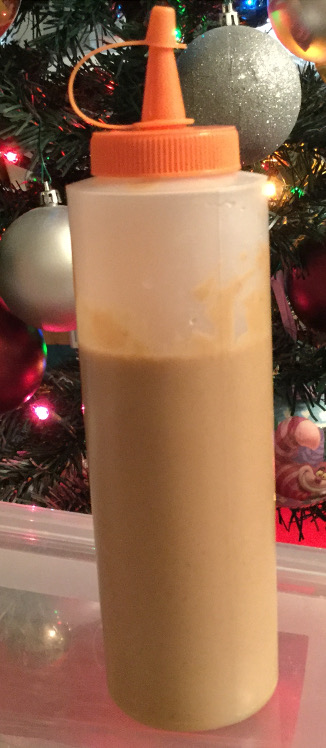
I made this one in the jar that came with my Ninja blender instead of the food processor. It just seemed like overkill to use an 11-cup appliance for a 1 cup amount of ingredients. I only used 1 tablespoon maple syrup because I'm running low, and used just a few drops of sriracha because I'm not a fan of spicy things, and even one drop of this stuff on some rice or veggies makes my tongue sweat.
OMG!!! This stuff is amazing! A nice fatty mouth feel, the sweetness of the syrup, the spiciness of the ginger and garlic, the little Hey! of the sriracha! That's a 1 1/2 cup squirt bottle, so you can see it made maybe a pinch over 1 cup of sauce. I'm in trouble - it's taking all of my willpower and strength NOT to just drink this stuff up! As much as I love it based on a bit on my finger wiped off the blender container, I just can NOT make this ever again! You know how Dr. McDougall says he could live on just potatoes? I would attempt to live on just this sauce! Lucky for me, though, my son loves peanut butter, even takes 2 sandwiches into work each day (He's finally off cheese! Yay!), so I'm sure he'll take this off my hands.
Friday, July 26, 2019
Dr. Klaper - Beyond Cholesterol - Freeing Yourself from the Tyranny of Your Cholesterol Numbers
I've seen some of these slides and graphics in talks by Dr. Esselstyn, also, especially the part about "foam" cells developing. It may have been in Dr. Essy's presentation at last year's Plantstock.
Thursday, June 6, 2019
Thursday, April 4, 2019
12 Essential Guidelines For Eating A Plant-Perfect Diet
By Ann Crile Esselstyn
Posted on Mind Body Green
So many years ago when my husband, Dr. Caldwell Esselstyn, published research that showed the power of plant-based, no-oil nutrition to arrest and reverse heart disease, I became the cook and our children the recipients of a plant-based diet. Since then, eating plant based has become part of who we all are, and none of us would ever look back with longing at the world of meat, grease and oil.
I wrote the recipes in my husband’s book, Prevent and Reverse Heart Disease, and our daughter, Jane, wrote the recipes in our son Rip’s second book, My Beef with Meat. With heart disease patients in mind, Jane and I have teamed up and written The Prevent and Reverse Heart Disease Cookbook.
We want to share with you some of the things we have learned along the way and most specifically what we recommend for those with heart disease or type 2 diabetes or for anyone who wants to lose weight.
Here's our 12-step plan for plant-perfect eating.
1. Eat no meat, pork, fish, fowl.
No flesh. None. Every cell in an animal is made of cholesterol. All meat also has saturated fat and animal protein. And research suggests that digesting meat releases a byproduct, trimethylamine oxide (TMAO), that's an even stronger predictor of heart disease than cholesterol. Avoid highly processed fake vegan and soy “meats” because they have a lot of oil in them.
2. Consume no dairy products.
Like meat, all dairy products contain cholesterol, saturated fat, animal protein, and casein. The protein in dairy is one of the most rel¬evant carcinogens identified. Avoid all highly processed vegan and soy cheeses, which are made with a lot of oil and often have added casein!
3. Eliminate oil!
Get rid of all the oil in your cupboards, even if it’s virgin olive oil, so that you can’t use it. Instead of using oil when you stir-fry and sauté vegetables, you can use vegetable broth (no sodium added), water, wine, beer, or vinegar. They all work well. Instead of relying on oil when you bake, use applesauce, apple butter without sugar, puréed prunes, or mashed ripe bananas. Balsamic vinegars are delicious on salad and the flavor-infused ones are stunningly good.
4. Eat whole-grain oats.
Old-fashioned rolled oats or steel-cut oats are good choices. Avoid the more processed “quick-cooking” or “instant” oats. Enjoy whole-grain oats for breakfast any way you can — either as oatmeal or a cold cereal with nondairy milk and fruit, or in the batter for waffles or pancakes.
5. Eat whole grains.
Be sure the word "whole" is in front of wheat or rye in the ingredient list. And be sure the word brown is in front of rice. If you don’t see “whole” in front of the grain on a bread label, it’s likely made with white flour fancied up to sound impressive. Many wonderful whole-grain products are available in the cooler section and the frozen food aisle.
6. Eat greens, especially leafy greens, as well as all the symphony of rainbow-colored vegetables.
Cooked or raw, vegetables are king! Make leafy greens — like kale, collards, and Swiss chard — the nest on which you put your food, mix greens directly into your food, or pile greens on the side of your plate. Mix greens into soup.
If you’re making pasta, add small pieces of kale or other leafy greens to the pot four minutes before the pasta is done then drain the whole pot, and you have a meal ready to go. Use collard leaves instead of burritos in a wrap. Roll a collard green up like a sushi roll. Mix a bunch of greens into pasta sauce and spread it on your whole wheat, no-oil pizza crust, then top with veggies — but, of course, no cheese.
7. Eat beans and lentils!
All beans and lentils are delicious and filling, and are healthy protein sources. Try red lentils in soup. They cook quickly and give the soup a nice color. Put beans in salads. Our hummus, which is made without tahini or oil, has become our “mayonnaise” for spreading on sandwiches, and is our favorite dip for vegetables and crackers. It’s even an ingredient in our favorite salad dressing.
Our main party dish is brown rice and black beans piled high with chopped tomatoes, thawed frozen corn, chopped scallions, water chestnuts, cilantro, chopped arugula, chopped peppers, and topped with salsa.
8. Avoid sugar as much as possible.
Always avoid drinking fruit juice. Eat the whole fruit instead. Read labels and avoid added sugars. Don’t get caught up thinking one sugar is better than another. Avoid them all as much as possible. Save sweets for birthdays or special holiday treats. Instead, put grapes in your freezer for an amazing sweet treat, or freeze bananas or mangoes and blend them in a high-speed blender or a “Yonanas” machine for delicious dairy-free “ice cream.”
Also, a little fruit or dried fruit added to a dish can really help sweeten it up. We use pure maple syrup in some recipes because it has the smallest amount of fructose of all sweeteners.
9. Avoid salt as much as possible.
Look at the government label for the amount of salt (sodium) in a product. No added salt is ideal, or aim for the salt content being equal to the calorie content or less. Instead of salt, add vinegar, lemon juice, lime juice, or low-sodium hot sauces for flavor. You will lose your taste for salt before you know it. Gourmet salts like Celtic salt and sea salt are no better. Don’t get caught up thinking one is better than another. Avoid them all as much as possible.
10. Steer clear of nuts, avocado, and coconut.
Instead, use 1 to 2 tablespoons of ground flaxseeds or chia seeds daily on cereal or in salads — both are excellent for omega-3 fatty acids. An occasional sprinkling of sesame seeds is fine.
11. Drink water!
You can’t go wrong with water. You'll save thousands of dollars and thousands of calories by just drinking water. Absolutely never drink sodas, artificially sweetened or not. Avoid smoothies. Don’t drink your calories; chew them. You can flavor water, soda water, or seltzer water with a splash of orange or apple juice occasionally, but never drink juice by the glass on a regular basis!
12. Read food labels, especially the ingredients.
You'll be surprised how often products that claim to have “zero fat” will list oil among their ingredients. The government allows anything under .5 grams of fat to be labeled fat free. Even products labeled trans fat free can have trans fat in them if you see partially hydrogenated oil as an ingredient! Shocking. Be vigilant!
By Ann Crile Esselstyn
Posted on Mind Body Green
So many years ago when my husband, Dr. Caldwell Esselstyn, published research that showed the power of plant-based, no-oil nutrition to arrest and reverse heart disease, I became the cook and our children the recipients of a plant-based diet. Since then, eating plant based has become part of who we all are, and none of us would ever look back with longing at the world of meat, grease and oil.
I wrote the recipes in my husband’s book, Prevent and Reverse Heart Disease, and our daughter, Jane, wrote the recipes in our son Rip’s second book, My Beef with Meat. With heart disease patients in mind, Jane and I have teamed up and written The Prevent and Reverse Heart Disease Cookbook.
We want to share with you some of the things we have learned along the way and most specifically what we recommend for those with heart disease or type 2 diabetes or for anyone who wants to lose weight.
Here's our 12-step plan for plant-perfect eating.
1. Eat no meat, pork, fish, fowl.
No flesh. None. Every cell in an animal is made of cholesterol. All meat also has saturated fat and animal protein. And research suggests that digesting meat releases a byproduct, trimethylamine oxide (TMAO), that's an even stronger predictor of heart disease than cholesterol. Avoid highly processed fake vegan and soy “meats” because they have a lot of oil in them.
2. Consume no dairy products.
Like meat, all dairy products contain cholesterol, saturated fat, animal protein, and casein. The protein in dairy is one of the most rel¬evant carcinogens identified. Avoid all highly processed vegan and soy cheeses, which are made with a lot of oil and often have added casein!
3. Eliminate oil!
Get rid of all the oil in your cupboards, even if it’s virgin olive oil, so that you can’t use it. Instead of using oil when you stir-fry and sauté vegetables, you can use vegetable broth (no sodium added), water, wine, beer, or vinegar. They all work well. Instead of relying on oil when you bake, use applesauce, apple butter without sugar, puréed prunes, or mashed ripe bananas. Balsamic vinegars are delicious on salad and the flavor-infused ones are stunningly good.
4. Eat whole-grain oats.
Old-fashioned rolled oats or steel-cut oats are good choices. Avoid the more processed “quick-cooking” or “instant” oats. Enjoy whole-grain oats for breakfast any way you can — either as oatmeal or a cold cereal with nondairy milk and fruit, or in the batter for waffles or pancakes.
5. Eat whole grains.
Be sure the word "whole" is in front of wheat or rye in the ingredient list. And be sure the word brown is in front of rice. If you don’t see “whole” in front of the grain on a bread label, it’s likely made with white flour fancied up to sound impressive. Many wonderful whole-grain products are available in the cooler section and the frozen food aisle.
6. Eat greens, especially leafy greens, as well as all the symphony of rainbow-colored vegetables.
Cooked or raw, vegetables are king! Make leafy greens — like kale, collards, and Swiss chard — the nest on which you put your food, mix greens directly into your food, or pile greens on the side of your plate. Mix greens into soup.
If you’re making pasta, add small pieces of kale or other leafy greens to the pot four minutes before the pasta is done then drain the whole pot, and you have a meal ready to go. Use collard leaves instead of burritos in a wrap. Roll a collard green up like a sushi roll. Mix a bunch of greens into pasta sauce and spread it on your whole wheat, no-oil pizza crust, then top with veggies — but, of course, no cheese.
7. Eat beans and lentils!
All beans and lentils are delicious and filling, and are healthy protein sources. Try red lentils in soup. They cook quickly and give the soup a nice color. Put beans in salads. Our hummus, which is made without tahini or oil, has become our “mayonnaise” for spreading on sandwiches, and is our favorite dip for vegetables and crackers. It’s even an ingredient in our favorite salad dressing.
Our main party dish is brown rice and black beans piled high with chopped tomatoes, thawed frozen corn, chopped scallions, water chestnuts, cilantro, chopped arugula, chopped peppers, and topped with salsa.
8. Avoid sugar as much as possible.
Always avoid drinking fruit juice. Eat the whole fruit instead. Read labels and avoid added sugars. Don’t get caught up thinking one sugar is better than another. Avoid them all as much as possible. Save sweets for birthdays or special holiday treats. Instead, put grapes in your freezer for an amazing sweet treat, or freeze bananas or mangoes and blend them in a high-speed blender or a “Yonanas” machine for delicious dairy-free “ice cream.”
Also, a little fruit or dried fruit added to a dish can really help sweeten it up. We use pure maple syrup in some recipes because it has the smallest amount of fructose of all sweeteners.
9. Avoid salt as much as possible.
Look at the government label for the amount of salt (sodium) in a product. No added salt is ideal, or aim for the salt content being equal to the calorie content or less. Instead of salt, add vinegar, lemon juice, lime juice, or low-sodium hot sauces for flavor. You will lose your taste for salt before you know it. Gourmet salts like Celtic salt and sea salt are no better. Don’t get caught up thinking one is better than another. Avoid them all as much as possible.
10. Steer clear of nuts, avocado, and coconut.
Instead, use 1 to 2 tablespoons of ground flaxseeds or chia seeds daily on cereal or in salads — both are excellent for omega-3 fatty acids. An occasional sprinkling of sesame seeds is fine.
11. Drink water!
You can’t go wrong with water. You'll save thousands of dollars and thousands of calories by just drinking water. Absolutely never drink sodas, artificially sweetened or not. Avoid smoothies. Don’t drink your calories; chew them. You can flavor water, soda water, or seltzer water with a splash of orange or apple juice occasionally, but never drink juice by the glass on a regular basis!
12. Read food labels, especially the ingredients.
You'll be surprised how often products that claim to have “zero fat” will list oil among their ingredients. The government allows anything under .5 grams of fat to be labeled fat free. Even products labeled trans fat free can have trans fat in them if you see partially hydrogenated oil as an ingredient! Shocking. Be vigilant!
Monday, July 23, 2018
Dr. Esselstyn -Nutritional Reversal of Cardiovascular Disease: Fact or Fiction
This talk was part of The Real Truth Symposium on February 9, 2018, but was just put on YouTube the other day.
This lecture not only explains the entire history of Dr. Esselstyn's eating guidelines, but goes over in detail what happens in your coronary arteries, including the function of all the little cells found in the space beneath the endocardial cells (Foam cells? Wow!). He Talks of all his guidelines, including the newest ones that incorporate high nitrate greens 6 times a day and why it's so important to have acetic vinegars, preferably balsamic, with them.
This is THE video to watch if you have heart disease and want to reverse it, or just want to prevent heart disease - or any the other diseases of humanity, from arthritis to cancer!
A word of warning - because it was a free conference and had a lot of sponsors, a lot of advertising pops up as banners across the bottom of the screen telling you who various sponsors are. After the first few you learn to just tune them out.
This lecture not only explains the entire history of Dr. Esselstyn's eating guidelines, but goes over in detail what happens in your coronary arteries, including the function of all the little cells found in the space beneath the endocardial cells (Foam cells? Wow!). He Talks of all his guidelines, including the newest ones that incorporate high nitrate greens 6 times a day and why it's so important to have acetic vinegars, preferably balsamic, with them.
This is THE video to watch if you have heart disease and want to reverse it, or just want to prevent heart disease - or any the other diseases of humanity, from arthritis to cancer!
A word of warning - because it was a free conference and had a lot of sponsors, a lot of advertising pops up as banners across the bottom of the screen telling you who various sponsors are. After the first few you learn to just tune them out.
Wednesday, May 3, 2017
Monday, March 6, 2017
Dr. Esselstyn Replies
Apparently, Dr. McDougall wrote him about it, and Dr. McDougall shared his reply on the forums:
John,
As I crawl from underneath the bus, it is essential for me to clarify your criticism of me in regards to this week’s committee authored American College of Cardiology (ACC) publication.
On page 1182 of the ACC paper there is reference to three of my publications immediately followed by the statement “On this basis, it appears that a whole food plant based diet may halt progression of coronary atherosclerosis and achieve evidence of angiographic disease regression.” The reference to my publications numbers 133, 134, and 135 appear on page 1187 of the ACC paper. To update you further, in 2016 I published an article in the Journal of The American College of Lifestyle Medicine entitled “Defining an Overdue Requiem for Palliative Cardiovascular Medicine” and I just completed a paper entitled “Coronary Artery Disease: A Mandate for Effective Therapy.” to be published later this year in a geriatric journal issue edited by Robert Ostfeld. In two weeks, on March 19th, I have been given 12 minutes to preset my research and clinical strategies how to prevent and reverse heart disease before the membership of the American College of Cardiology in Washington, D.C.
My point is that in none of these writings or presentations in the past, present, or future have I deviated from my “NO OIL” plant based nutrition message.
While I would like nothing more than to have the ACC paper echo my hard and fast no oil plant based approach, you can appreciate the conflicts of some of the authors resulting in compromise and in brutal editing, not surprising in a committee authored article.
Thank you for sharing my response with your audience.
Es
As a reminder, the whole thread with links to the study can be found here.
Wednesday, March 1, 2017
New Cardio-Vascular Disease Study Results
Jeff Novick posted this over on the McDougall forums. He has the thread locked so nobody can reply, so here it is in its entirety.
(Edited to add:)
Looks like Dr. Fuhrman was right all along. Maybe his program deserves another look.
Trending Cardiovascular Nutrition Controversies- Nuts, Oil..
Just published in the Journal of the American College of Cardiology.
The authors include Dr Barnard, Dr Esselstyn, Dr Ornish & Dr Williams
Trending Cardiovascular Nutrition Controversies
(J Am Coll Cardiol 2017;69:1172–87)
Andrew M. Freeman, MD,a Pamela B. Morris, MD,b Neal Barnard, MD,c Caldwell B. Esselstyn, MD,d, Emilio Ros, MD, PHD,e Arthur Agatston, MD,f Stephen Devries, MD,g,h James O’Keefe, MD,i Michael Miller, MD,j Dean Ornish, MD,k Kim Williams, MD,l Penny Kris-Etherton, PHDm
Full text
http://www.onlinejacc.org/content/69/9/1172
Abstract
The potential cardiovascular benefits of several trending foods and dietary patterns are still incompletely understood, and nutritional science continues to evolve. However, in the meantime, a number of controversial dietary patterns, foods, and nutrients have received significant media exposure and are mired by hype. This review addresses some of the more popular foods and dietary patterns that are promoted for cardiovascular health to provide clinicians with accurate information for patient discussions in the clinical setting.
A Look to the Future
In summary, the future health of the global population largely depends on a shift to healthier dietary patterns (Central Illustration). However, in the search for the perfect dietary pattern and foods that provide miraculous benefits, consumers are vulnerable to unsubstantiated health benefit claims. As clinicians, it is important to stay abreast of the current scientific evidence to provide meaningful and effective nutrition guidance to patients for ASCVD risk reduction. In this brief review, just a few of the current trends in nutrition have been highlighted to serve as a starting point for the patient-clinician discussion. Available evidence supports CV benefits of nuts, olive oil and other liquid vegetable oils, plant-based diets and plant-based proteins, green leafy vegetables, and antioxidant-rich foods (Central Illustration). Although juicing may be of benefit for individuals who would otherwise not consume adequate amounts of fresh fruits and vegetables, caution must be exercised to avoid excessive calorie intake. There is currently no evidence to supplement regular intake of antioxidant dietary supplements. Gluten is an issue for those with GRDs, and it is important to be mindful of this in routine clinical practice; however, there is no evidence for CV or weight loss benefits, apart from the potential caloric restriction associated with a gluten-free diet.
Summary Chart
The authors include Dr Barnard, Dr Esselstyn, Dr Ornish & Dr Williams
Trending Cardiovascular Nutrition Controversies
(J Am Coll Cardiol 2017;69:1172–87)
Andrew M. Freeman, MD,a Pamela B. Morris, MD,b Neal Barnard, MD,c Caldwell B. Esselstyn, MD,d, Emilio Ros, MD, PHD,e Arthur Agatston, MD,f Stephen Devries, MD,g,h James O’Keefe, MD,i Michael Miller, MD,j Dean Ornish, MD,k Kim Williams, MD,l Penny Kris-Etherton, PHDm
Full text
http://www.onlinejacc.org/content/69/9/1172
Abstract
The potential cardiovascular benefits of several trending foods and dietary patterns are still incompletely understood, and nutritional science continues to evolve. However, in the meantime, a number of controversial dietary patterns, foods, and nutrients have received significant media exposure and are mired by hype. This review addresses some of the more popular foods and dietary patterns that are promoted for cardiovascular health to provide clinicians with accurate information for patient discussions in the clinical setting.
A Look to the Future
In summary, the future health of the global population largely depends on a shift to healthier dietary patterns (Central Illustration). However, in the search for the perfect dietary pattern and foods that provide miraculous benefits, consumers are vulnerable to unsubstantiated health benefit claims. As clinicians, it is important to stay abreast of the current scientific evidence to provide meaningful and effective nutrition guidance to patients for ASCVD risk reduction. In this brief review, just a few of the current trends in nutrition have been highlighted to serve as a starting point for the patient-clinician discussion. Available evidence supports CV benefits of nuts, olive oil and other liquid vegetable oils, plant-based diets and plant-based proteins, green leafy vegetables, and antioxidant-rich foods (Central Illustration). Although juicing may be of benefit for individuals who would otherwise not consume adequate amounts of fresh fruits and vegetables, caution must be exercised to avoid excessive calorie intake. There is currently no evidence to supplement regular intake of antioxidant dietary supplements. Gluten is an issue for those with GRDs, and it is important to be mindful of this in routine clinical practice; however, there is no evidence for CV or weight loss benefits, apart from the potential caloric restriction associated with a gluten-free diet.
Summary Chart

Looks like Dr Esselstyn just put his name on a published paper endorsing nuts & oils
In Health
Jeff
In Health
Jeff
Subscribe to:
Posts (Atom)